


賴佩霞:靜心,是回歸自我,聽見内心的聲音
October 28, 2025
Lawak Kampus Origin: Daripada Lakaran ke Dunia Nyata
December 2, 2025賴佩霞:靜心,是回歸自我,聽見内心的聲音
October 28, 2025Lawak Kampus Origin: Daripada Lakaran ke Dunia Nyata
December 2, 2025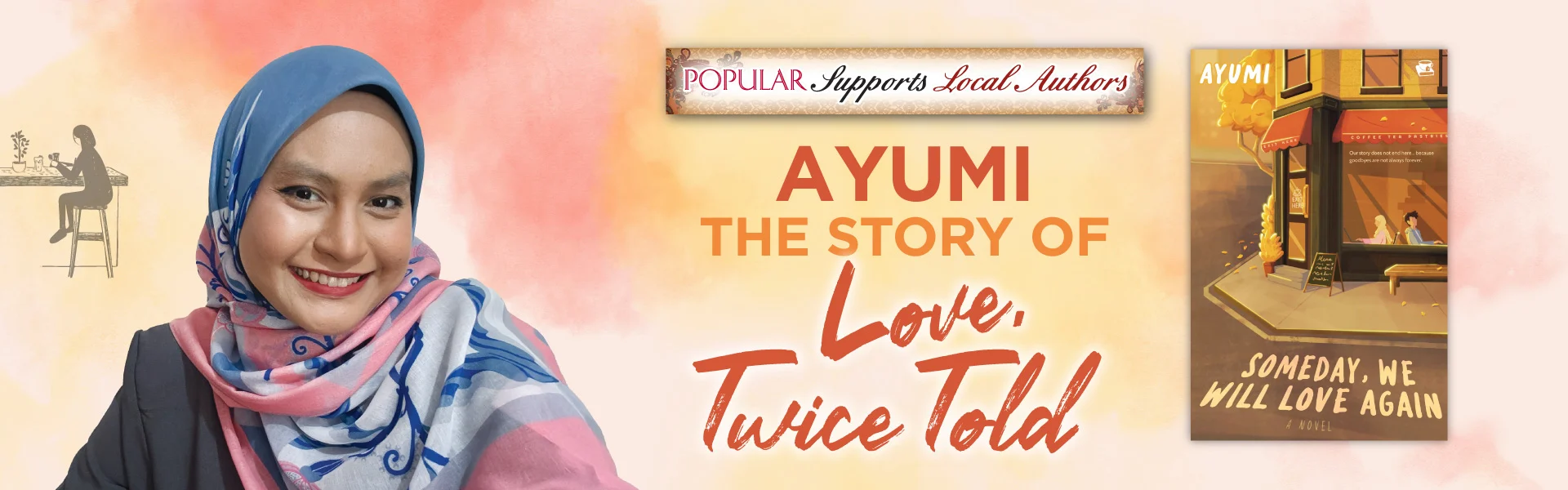
The Story of Love, Twice Told
“Rewriting the story, I wrote at 22 felt like meeting an old friend again.” - Ayumi
The most challenging character for novelist Ayumi, born Ummi Syafiqah, ever had to write was a version of herself from a decade ago.
In the world of local publishing, Ayumi is an author of nearly 40 books across genres from romance to thrillers. But her latest novel, Someday, We Will Love Again, presents a unique test. It wasn’t a new story, but an old one, a “ghost” from her past that demanded to be resurrected and revised.
The book, a tension-filled narrative exploring the clash between love and ambition, was first drafted when she was a 22-year-old grappling with a classic “what if” scenario. Back then, it was titled Once Upon a Bucket List. A decade later, the manuscript was little more than a digital memory until the publishing house Iman discovered its existence and made a surprising proposal: rewrite it.
“It was like meeting an old friend,” Ayumi, now 32, told POPClub from her home in Kuala Terengganu. The journey of Someday, We Will Love Again is more than a simple tale of a second draft. It is a map of a writer’s evolving psyche, a case study in how the passage of time can fundamentally alter a story’s DNA. For Ayumi, the rewrite became a conversation between her younger and present selves, mediated by the very characters she once created.
The bones of the past
The original plot centred on a young woman, Shika, racing to complete a bucket list before studying abroad. The new version, however, sheds this specific framework. “The rewritten version is more mature, with a different style,” Ayumi noted. The core question—ambition or love, came up, and the context deepened, reflecting the more nuanced understanding of life that comes with a decade of lived experience.
The revision process was intense, compressed into a demanding two-month period that coincided with her recovery from shoulder surgery. “I have a reputation for writing very fast,” she said, a necessary skill when working against a deadline with one hand temporarily out of commission. But the speed belied the emotional weight of the task. She wasn’t just editing prose; she was re-evaluating the worldview of her 22-year-old self.
“My view on love and relationships changed,” Ayumi stated plainly. “That’s why the story changed.” Where the first draft may have presented a more simplistic, perhaps idealised view of romance, the final version is tempered by a harder-won realism.
Writing a body’s truth
Perhaps the most profound change in the rewrite was the deepening of the protagonist, Shika, who lives with hypermobility syndrome, a connective tissue disorder that causes joint pain and instability. It was deeply personal. Ayumi herself has the same condition. “Everything she goes through is what I go through,” she revealed. In writing Shika’s struggles and her relentless spirit, Ayumi was not creating a fictional narrative but channelling a real one. Shika became less of a pure self-insert and more of an aspirational self—the resilient, outspoken woman Ayumi wishes she could be.
“I hope the audience, especially those struggling with difficulties in their lives… knows they are not alone,” she said. “They know if Shika can do it, they can do it too.” The character’s strength, forged in the fires of chronic pain, is a direct message to readers facing their own battles.
The ‘halal romance’ challenge
The rewrite came with an unexpected creative constraint from her new publisher: the romance had to be halal, adhering to Islamic principles that prohibit premarital intimacy and dating as it is conventionally portrayed in Western media.
For a romance writer, this could easily be seen as a limitation. Ayumi saw it as a masterclass in tension. “That’s the challenge,” she said, a hint of excitement in her voice. “You need to be very creative in maintaining the chemistry between two characters.” The relationship between Shika and the male lead, Dylan, whom Ayumi describes as her “dream man,” a composite of gentle, supportive traits from her favourite Hollywood characters, had to be built on meaningful interactions, lingering glances, and unspoken understanding rather than physical escalation.
“You have to be very creative when writing dialogue,” she explained. “Because it’s easy to become repetitive and also easy to make it cringey if you write the wrong thing.” This focus on emotional and verbal chemistry resulted in a slow-burn narrative that she believes is fresh and engaging, proving that the heart of romance lies in connection, not just consummation.
The legacy of a story
Now, with Someday, We Will Love Again on shelves, Ayumi has closed a decade-long loop. The book stands as a testament to her growth not just as a writer, but as a person. The title, chosen by her publishers, now holds a dual meaning for her: it is the hope held by her characters, but also a reminder of the feeling she had when she first put pen to paper, all those years ago.
“It is a reminder,” she said softly. “It is a feeling I had when I wrote the story. So, I will always… love the feeling I had when I wrote the story.”
For Ayumi, the novel is more than a product. It is a chronicle of a self, twice told. It is the proof that sometimes, to move forward, a writer must first find her way back, and that the most compelling stories aren’t just the ones we invent, but the ones we live and, when we are lucky, get to tell again.