


The Ending Writes Itself: V.E. Schwab and Cat Clarke’s Secret Collaboration Revealed
2026年5月5日
From Corporate Career to Gothic Horror: Shareen Ho’s Journey Behind Daughters of the Mire
2026年5月5日The Ending Writes Itself: V.E. Schwab and Cat Clarke’s Secret Collaboration Revealed
2026年5月5日From Corporate Career to Gothic Horror: Shareen Ho’s Journey Behind Daughters of the Mire
2026年5月5日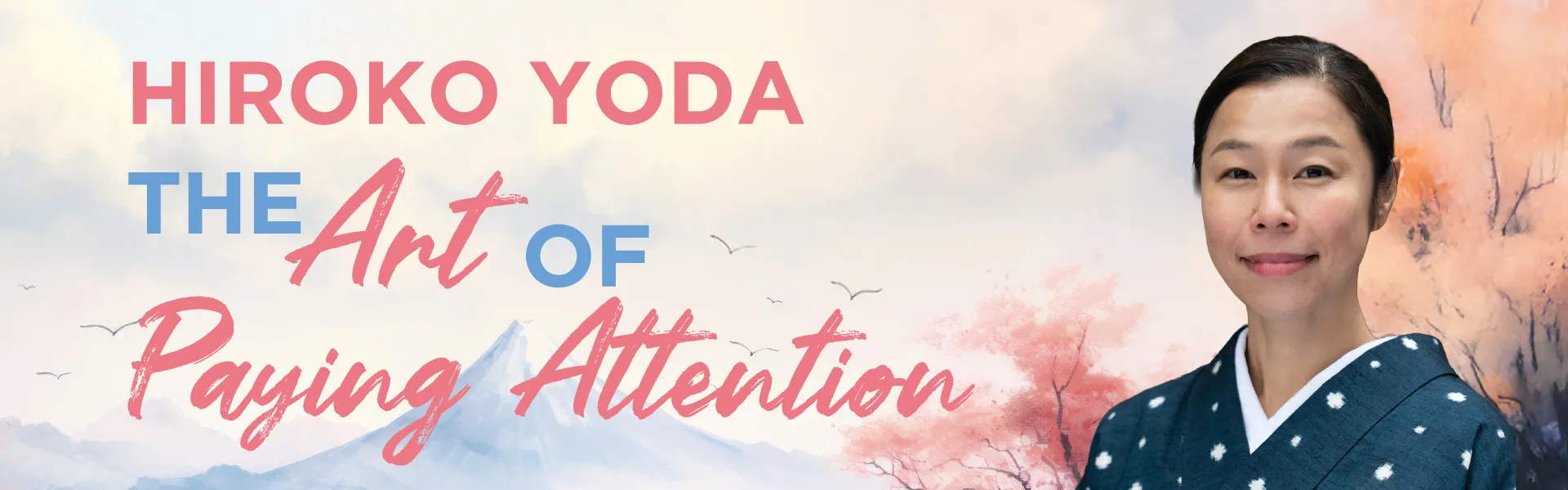
Hiroko Yoda and Eight Million Ways to Happiness: Rediscovering Gratitude Through Japanese Spirituality
Text | Larissa Lumandan
Photo | Hiroko Yoda
Everything has a spirit. The heavens above, the ground below, the trees, the rocks, the rivers, the seas, even the words we speak. – Hiroko Yoda
In an age of endless scrolling and quiet existential fatigue, Hiroko Yoda offers a different kind of antidote—not a doctrine or a system, but a gentle recalibration of how we notice the world. Her latest book, Eight Million Ways to Happiness, invites readers to rediscover meaning through something deceptively simple: gratitude.
Speaking on the Thought Echoes podcast, Yoda describes her work not as a guide to happiness in the conventional sense, but as an exploration of perspective. Rooted in Japanese spirituality, the book draws on the concept of yaoyorozu-no-kami, often translated as “eight million kami,” and more accurately understood as an infinite presence of spirit in all things. It’s a worldview that resists neat translation. Kami are not gods in the Western sense, Yoda explains. According to her, they are everywhere—in nature, in objects, in connections. Within this framework, the boundary between the sacred and the mundane dissolves. A banana, a TV set, even a passing breeze can become a portal into awareness, if one is paying attention. That attention, Yoda suggests, is where modern life falters.
Learning to See Again
Her own journey toward this philosophy was not academic, but deeply personal. The book was born from grief following her mother’s passing, a loss she describes as a “massive void.” What followed was not an immediate awakening, but a slow, almost reluctant re-entry into the world. She began by walking—first aimlessly, then with increasing awareness. The sky, the movement of clouds, the quiet persistence of ants underfoot—these small details became anchors.
“I thought I was just absolutely alone,” she said. “But when I opened my eyes—and my heart—I realised I was surrounded by many forms of life.”
It is this shift—from isolation to interconnectedness—that forms the emotional core of Eight Million Ways to Happiness. Rather than prescribing rituals, Yoda offers invitations: take a walk without your phone, notice the origins of your food, consider the invisible network of people, labour, and nature that makes even the simplest moment possible.
In Japan, this awareness is embedded in everyday language. The phrase itadakimasu, said before meals, loosely translates to “I humbly accept.” As Yoda points out, it carries a deeper resonance—an acknowledgment of everything that brought the meal into being, from soil and sunlight to farmers and shopkeepers. Gratitude, in this sense, is not performative but perceptual.
Where Gratitude Is Enough
Yoda’s background as a folklorist—she previously co-authored books on yokai, ninja, and ghosts—shapes her ability to translate complex cultural ideas for a global audience. Yet she resists over-explaining; some concepts, she suggests, are meant to be experienced rather than defined.
There is also a quiet sense of expansiveness in her approach. At a time when many seek meaning through rigid systems or carefully curated identities, Yoda offers something more open-ended. Happiness, she suggests, is not a fixed destination, but an accumulation of moments—infinitely varied and endlessly accessible.
Not everyone wants to belong to a specific belief system, but everyone can experience gratitude, she says.
In that sense, Hiroko shows how Japan's flexible approach to spirituality helps kindle gratitude, connection and kinship with nature. What emerges are practical insights and gentle guidance to spark joy, find balance, and discover what truly matters.